Powerful Cycles: Riding the Rhythm and Transcending Beyond with M&A

Miranda Zhao
Head of M&A, Asia Pacific & Middle East,
Natixis CIB
Over the past few years, we have lived through sharp downturns, uneven recoveries, and a K‑shaped pattern where some corners of the market soared while others stalled. In an earlier article, I compared navigating a downturn to training for the Olympic Games: embracing realism about the environment but holding onto optimism about what disciplined effort can achieve over time. Today, as signs of recovery emerge in global and regional M&A, the question is less “Is the cycle turning?” and more “How do we ride the rhythms effectively and transcend beyond cycles?”
Across regions in Asia Pacific and Middle East (“APME”), the data tells a clear story. Volumes are recovering, but not evenly. Asia mirrors this global pattern but with its own internal divergences and characters: Greater China, Japan, Southeast Asia, India, and the Middle East each move to a different rhythm, even as they are tied into the same global capital flows.
China: Strategic reset through the unique lens of Hong Kong’s cross-border market
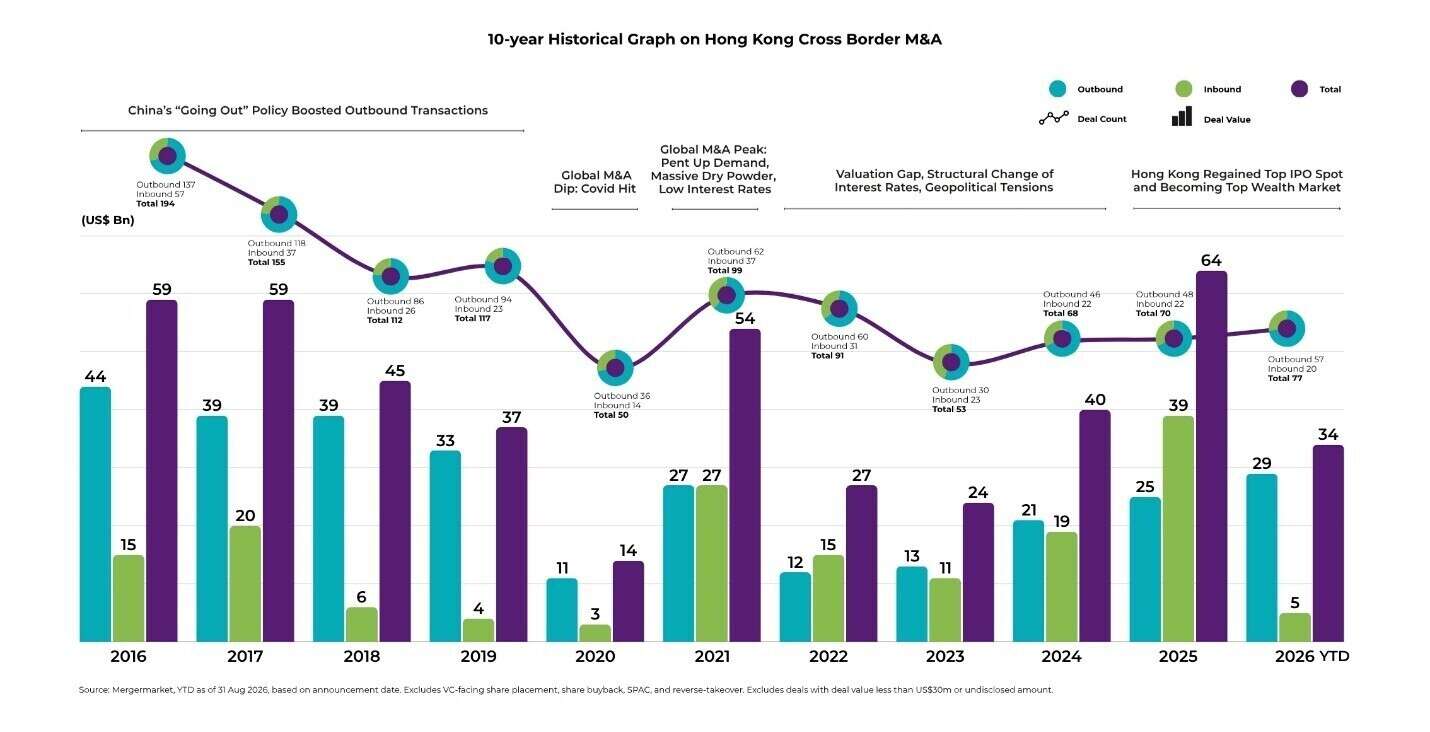
Hong Kong is a market with unique character. It is deeply linked to China, connected to global investors, and anchored in a legal and regulatory framework which encourages complex cross‑border deals to happen. Through Hong Kong cross-border capital flow in M&A and capital raisings, we see China’s transformative strategic reset from outbound boom to inward realignment, and a sector rotation from growth and scale driven to efficiency and innovation anchored. Cycles in IPOs and M&A here have tracked global turbulence and recovery, yet underneath the volatility is a long‑standing infrastructure of trust, governance, and investor depth. It is a reminder that some elements of a market’s value are cyclical, and some are structural.
Japan: Empowered momentum and fundamental mindset shifting
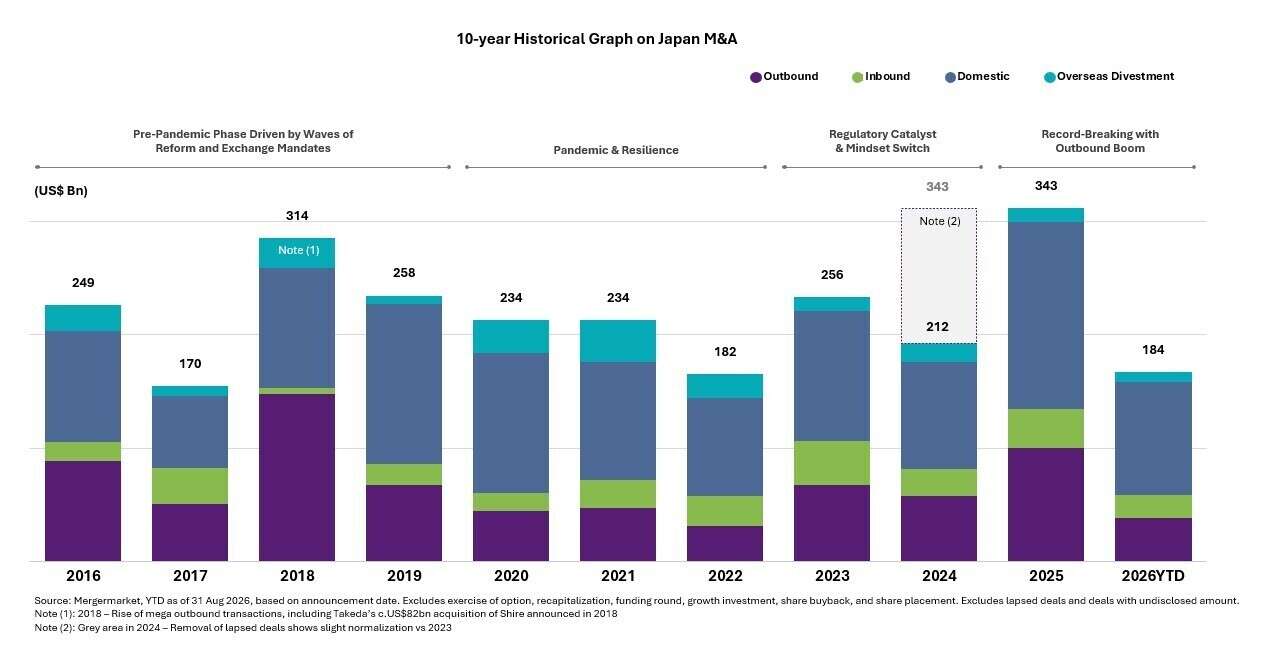
Japan’s experience shows another dimension of cycles and resilience. After several years of reform‑driven momentum, 2025 emerged as a high‑water mark for Japan M&A, characterized by numerous domestic and cross‑border mega deals that drove peak large‑scale transaction activity. 2026 has so far sustained the activity level with domestic volumes contracted slightly but offset by rising cross-border transactions, driven by a fundamental need for global expansion, group restructuring and value creation. Financial sponsors have become a key catalyst with increasing deal value. The 2025 peak compared to 2018 spike is uniquely characterized by a more proactive approach in value driven corporate restructuring, explosive growth in activism, rising share of global private equity in mega buyouts, massive interest gaps in comparison globally, and structurally weak Yen. This is set against the backdrop of a potential turning point of decades of stagnation.
This pattern captures how cycles evolve in a more matured market in a cash rich, lower interest rate and growth seeking environment.
India: Robust domestic liquidity and favorable government policies
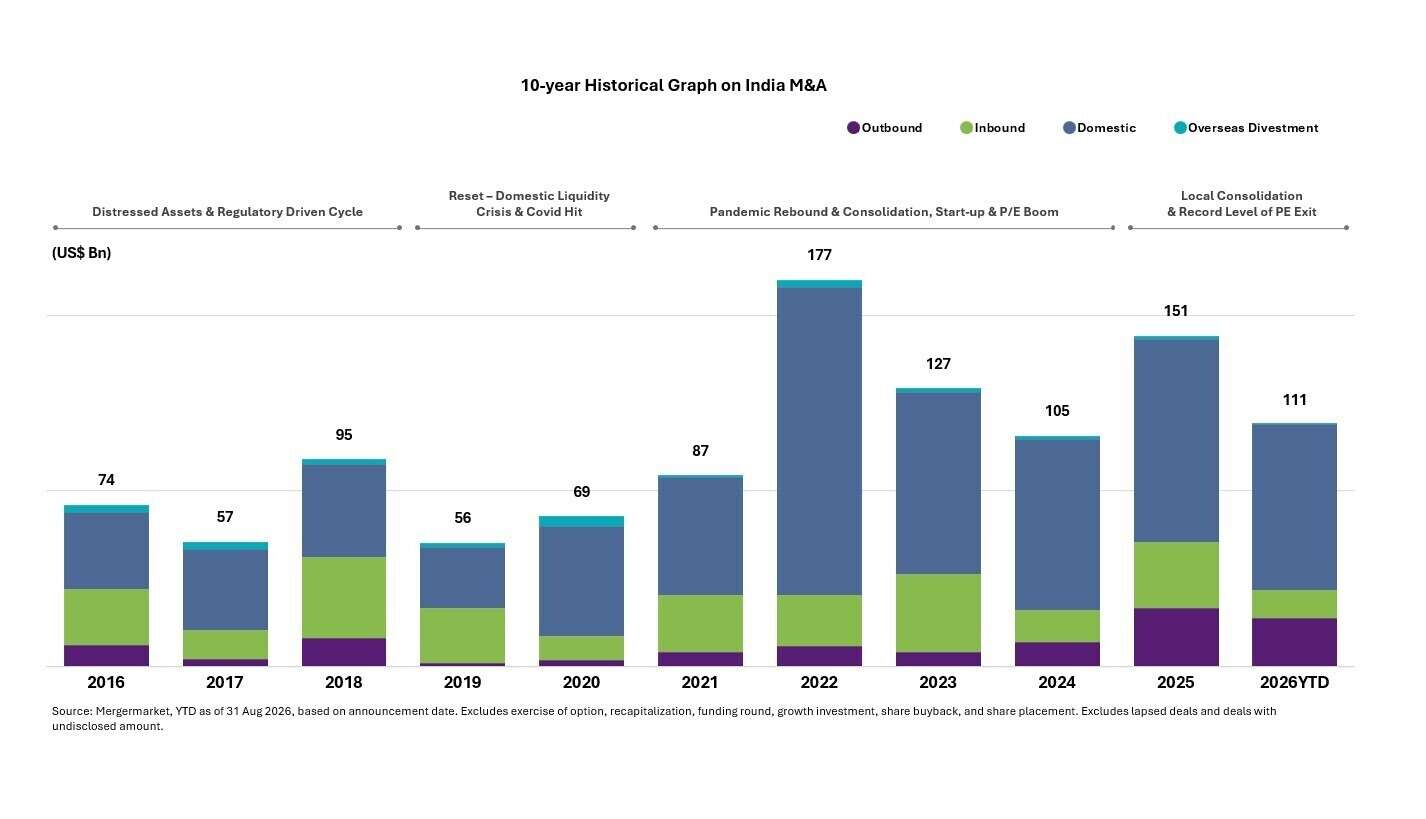
India offers a complementary picture. The Indian M&A market experienced a significant surge in 2018 due to policy reforms on foreign investment cap which fueled inbound M&A, its Insolvency and Bankruptcy Code (“IBC”) to unlock distressed assets, plus private equity and venture capital’s dry powder into technology and telecom sectors. Followed by a year of reset in 2019 due to local liquidity crunch, which resulted in a sharp decrease of mega deals, plus outbound transactions and PE exit collapse post 2018 peak. The Indian market shows unique pattern with 2022 as its peak for post covid rebound, against the global and APME regional 2021 surge, due to India’s startup and unicorn boom, mega banking consolidation ($40bn HDFC merger in 2022), and the rise of PE activities (both buyout and exit). Post a slight correction, 2025 was another strong comeback year boosted by a return of large strategic transactions, strong domestic consolidation and IPO market enabled PE boom.
The cycle of the India market seems to follow a highly sentiment, liquidity driven and policy enabled pattern, where deal value swings far more sharply than deal numbers. The current India M&A market momentum is heavily underpinned by robust domestic liquidity and favorable government policies—including rising manufacturing incentives—as well as high consumer confidence and sustained government spending on large-scale infrastructure projects.
Middle East: Policy driven, SWF-fueled and energy price-linked
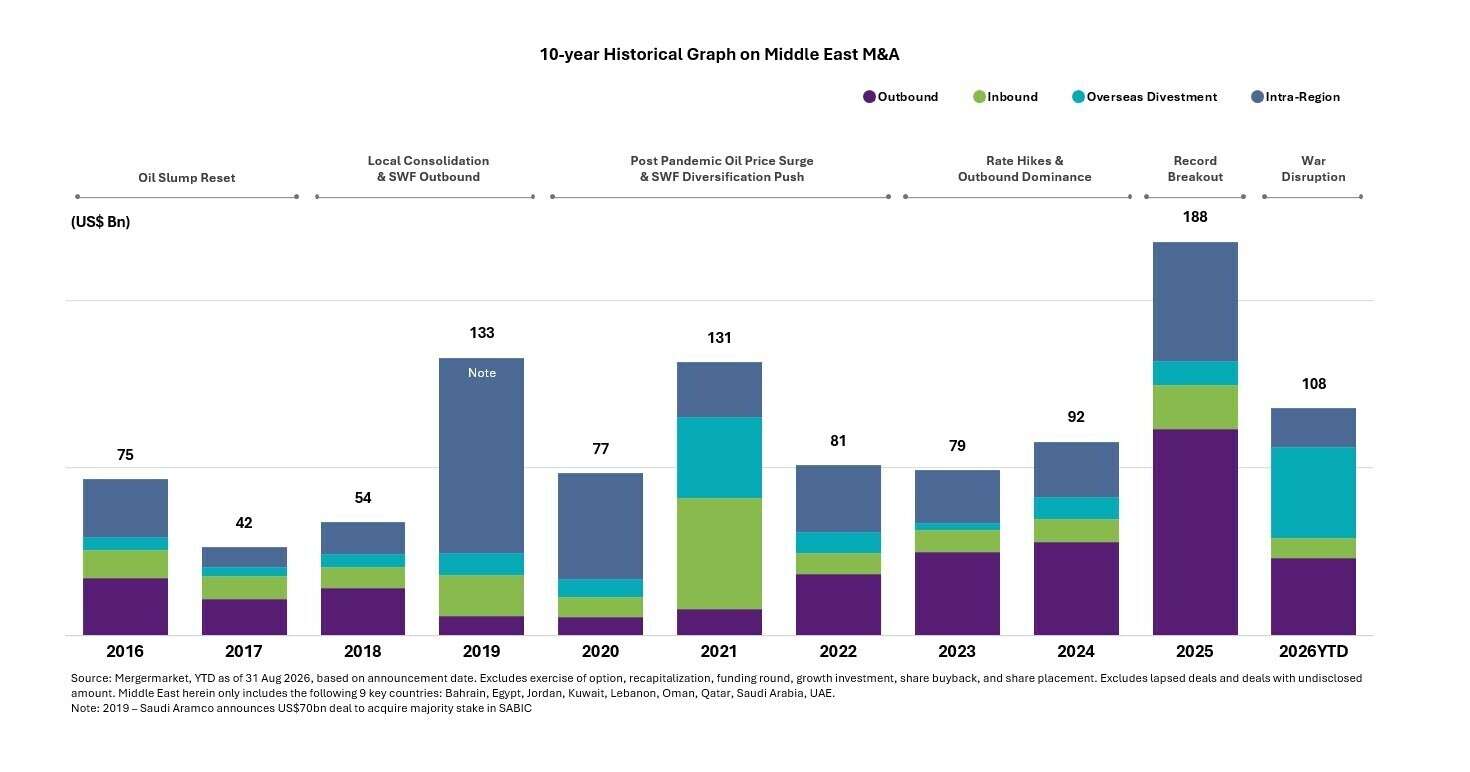
The Middle East has begun to move through its own cycle: less about short‑term ups and downs, more about a deep structural shift, with rising deal value and sector diversification. Sovereign and long‑term capital are diversifying away from hydrocarbons, deploying into technology, renewables, logistics, and consumer sectors, and forming new corridors with Europe and Asia Pacific.
Middle East cycles are policy driven, SWF-fueled and energy price-linked, making it less sensitive to other emerging market patterns.
Conclusion
Across all these regions, M&A plays a critical role in every phase of the cycle. In booms, it enables growth, penetration, and scale. In downturns, it allows restructuring, rescue, and renewal. In transitions, it reallocates capital from where it is less productive to where it can do more. At its best, M&A is a mechanism for re‑shaping industries in ways that should serve broader human needs: better services, more resilient jobs, more sustainable business models.
But riding cycles wisely requires more than financial skill. It requires character.
When markets rise, we are tempted to believe we are smarter than the cycle. When they fall, we are inclined to believe the cycle is stronger than we are. Both are illusions. To everything there is a season, and to every industry there are cycles. Cycles are powerful, but they are not personal, and we should not be defined by cycles. Our moral and spiritual challenge is to stay grounded in values that do not move up and down with short-term turbulence: integrity, discipline, drive for excellence, and a long‑term sense of purpose.
In that sense, wise participation in M&A cycles is a spiritual practice as much as a professional one. It asks us to look beyond timing the peaks and troughs, and to focus on outlasting them—by building assets, relationships, and ecosystems that remain valuable across many seasons. Riding powerful cycles wisely is not about outsmarting the market. It is about aligning capital with enduring human values and embarking on the right kind of journey with our clients, our colleagues, and ourselves.